
For Patients
Spine Treatment Without Surgery
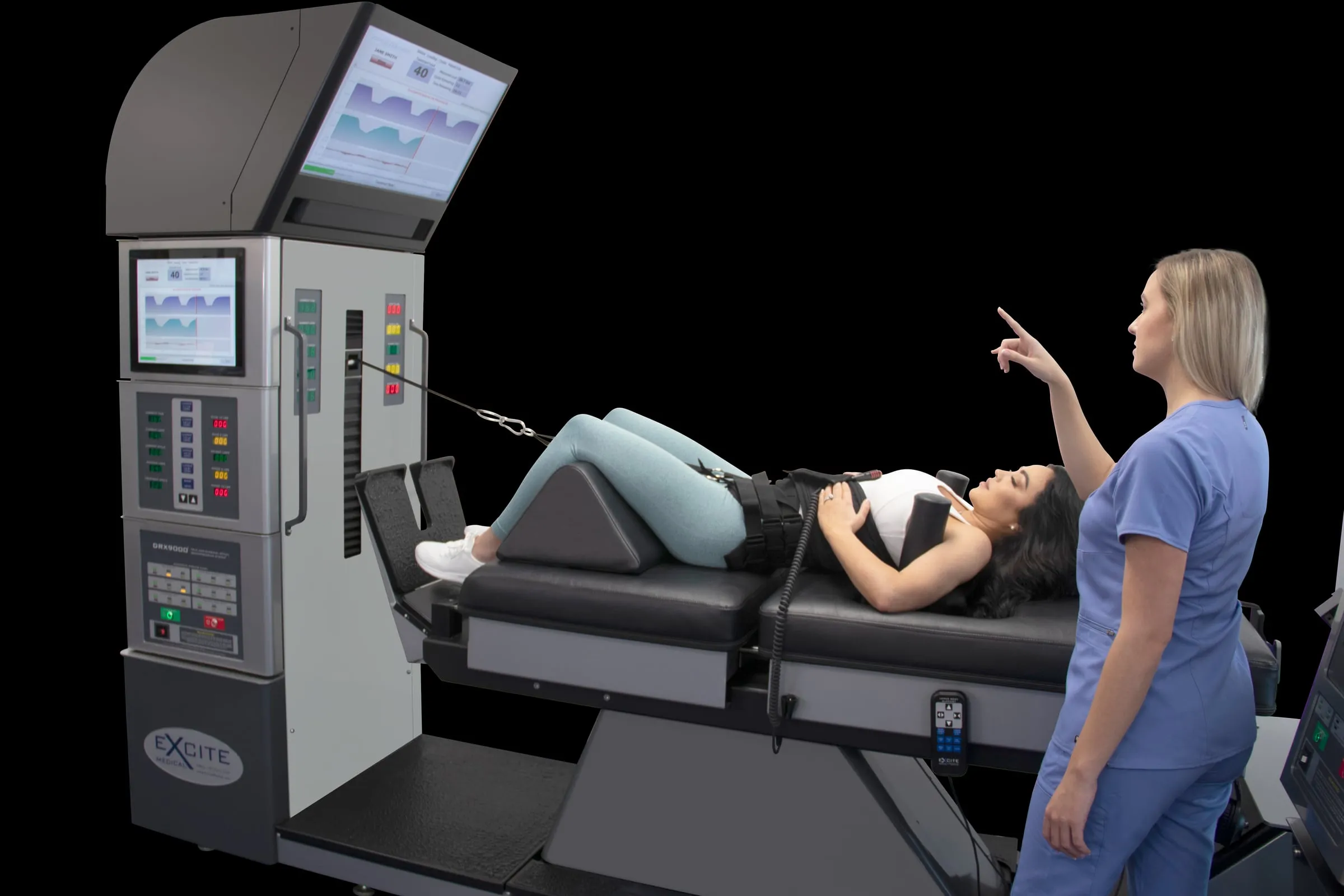
DRX™ systems gently offload one spinal segment: the one that actually hurts. Below is everything worth knowing before your first visit to a physician: how the method works, who it is suited for, and how a course of treatment is structured.
The Method
What Is the DRX Method?
It is targeted decompression: a physician-controlled computer separates the two adjacent vertebrae that surround the damaged disc.
Conventional forms of spinal traction, whether a pull-up bar, underwater traction, or a standard traction table, stretch the entire spine at once. Only a small share of the force reaches the affected segment where the herniation or compressed disc is located, so this kind of traction brings only short-lived improvement.
DRX™ systems work differently. Using MRI findings, the physician selects a single segment: from L1–L2 to L5–S1 in the lumbar spine, and from C3–C4 to C7–T1 in the cervical spine. The device sets the angle of pull toward that specific disc and smoothly separates the two adjacent vertebrae.
According to the developers of the method, this separation lowers the pressure inside the disc and creates a so-called vacuum effect. Fluid that nourishes the disc tissue is drawn in, and the disc, like a sponge, regains volume. The herniated material is partially drawn back inward, stops pressing on the nerve roots, and the pain subsides.
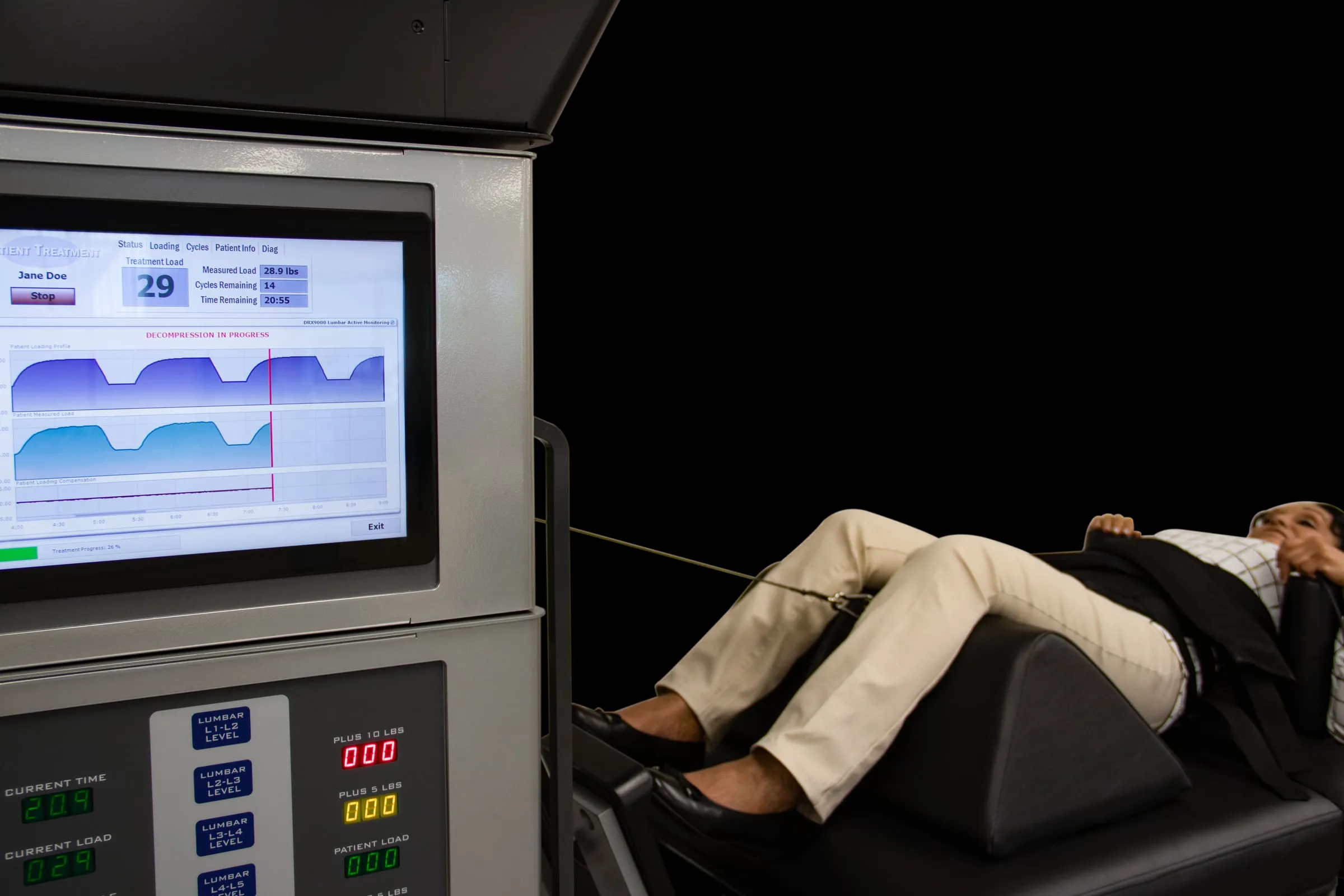
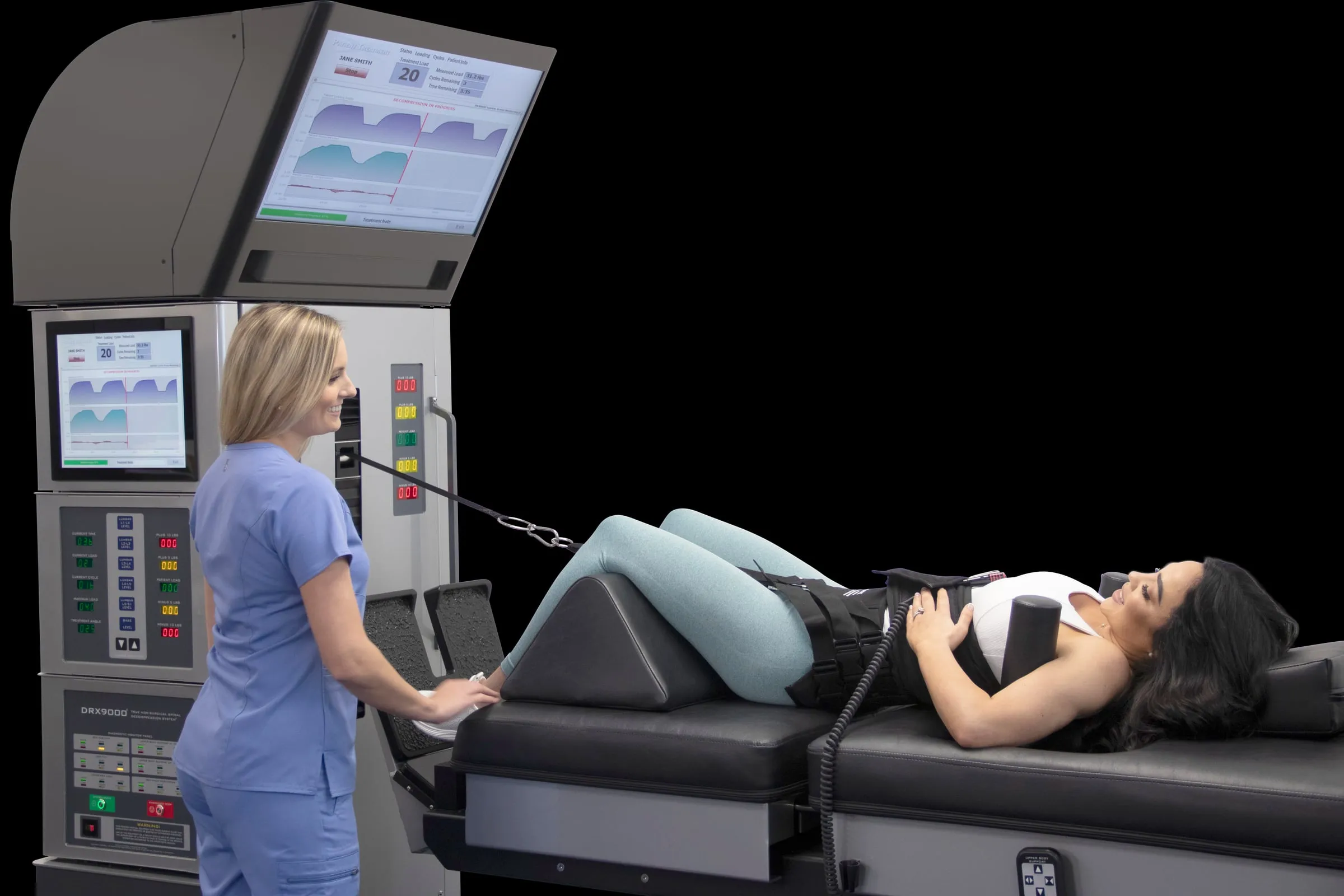
Tension rises and falls along a logarithmic curve: quickly at first, then gradually. This keeps the back muscles from tightening into a protective spasm, so the patient stays relaxed throughout the procedure. The device measures the load continuously and adjusts it to the value set by the physician.
What matters most for the patient: treatment is delivered without surgery, with no incisions and no anesthesia, which means no surgical risks and no lengthy recovery.
The Difference
How DRX Differs from Conventional Traction
-
One Segment, Not the Whole Spine
The angle of pull is set from the MRI so the force is directed at the disc that is causing the pain. -
A Smooth Logarithmic Curve
The tension-and-relaxation cycle repeats many times per session, so the muscles don’t have time to go into spasm. -
Computer-Controlled Load
Tension is measured continuously and corrected to the set value. A built-in scale accounts for the patient’s body weight. -
The Physician Directs Every Session
The physician sets the force and angle of pull and adjusts them from session to session as needed. -
A Safety Button in the Patient’s Hand
The patient can press the button at any time, and the tension is released immediately. -
Comfort During the Procedure
The patient lies on their back and can watch a movie on the screen or listen to calming music.
Indications
Who May Benefit from DRX Treatment
The decision to treat is always made by a physician after an examination and a review of the MRI. The list below is based on materials from the manufacturer and ELTECH and is not a substitute for a consultation.
-
Herniated Discs
Lumbar and cervical disc herniations, including large and long-standing ones. -
Bulging Discs
Disc protrusion without a tear of the annulus fibrosus. -
Recurrent Herniations, Including After Surgery
Per the manufacturer’s protocol: no sooner than 6 months after surgery for the lumbar spine and no sooner than 12 months for the cervical spine. A prior lumbar spinal fusion rules out treatment. -
Radiculopathy and Sciatica
Pain radiating into the leg or arm due to a compressed nerve root. -
Osteochondrosis, Degenerative Disc Disease, Spondylosis
Age-related disc changes that cause pain and limit mobility. -
Facet Syndrome
Pain arising from the small intervertebral (facet) joints. -
Rehabilitation After Spine Surgery
The method can be part of a postoperative rehabilitation protocol. -
Prevention and Sports Rehabilitation
DRX™ systems are used in the early stages of degenerative disc disease, in athlete rehabilitation, and at health resorts and sanatoriums.
Safety
Contraindications
This list combines ELTECH’s contraindications with the exclusion criteria from the manufacturer’s protocols. The final decision rests with the treating physician.
DRX treatment is not performed in patients with:
- pregnancy;
- cancer: spinal tumors, metastatic cancer, or cancer of the abdominal or pelvic organs;
- spinal instability, including unstable spondylolisthesis (above grade 1) and pars interarticularis defects;
- spinal fractures, including a recent compression fracture;
- severe osteoporosis or any condition that softens bone tissue;
- metal hardware in the spine (implants, prostheses, artificial discs) or a prior lumbar spinal fusion;
- infections of the spine or intervertebral disc, such as tuberculosis or osteomyelitis;
- a sequestered herniation, where a fragment has broken off from the herniated disc;
- a pathological aortic aneurysm;
- severe peripheral neuropathy;
- hemiplegia, paraplegia, or cognitive impairment.
Additionally, for cervical treatment: spinal canal stenosis with spinal cord compression, vascular disorders of the carotid or vertebral arteries, a prior stroke, congenital anomalies of the cervical spine, or very fragile or swollen skin where the head is secured.
Acute pain. In an acute flare-up with pronounced muscle spasm, the physician first brings the flare-up under control with other methods and only then starts a DRX course.
What may reduce the effect. The manufacturer’s protocols list smoking, excess weight, long-term use of opioid painkillers or steroids, extensive scarring after surgery or injury, and too long a break in treatment after the first two weeks of the course.
The Procedure
What Happens During a Session
- 01
Consultation and MRI
The physician performs an examination and reviews an MRI of the lumbar or cervical spine. The images show which segment to treat and which must not be loaded. - 02
Weighing and Positioning
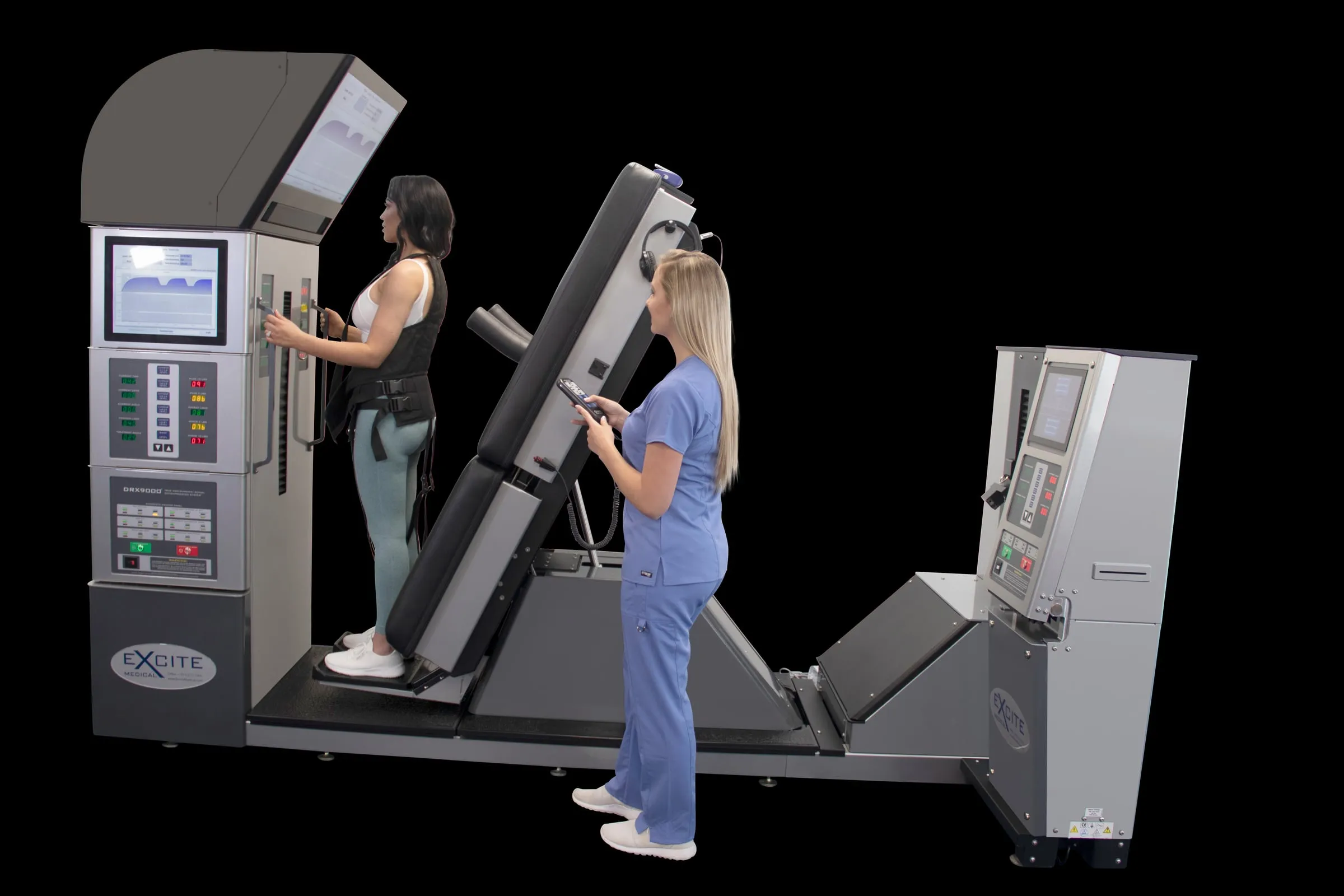
The patient steps onto the built-in scale platform, and the device accounts for body weight. Staff fit pelvic and chest harnesses of the right size. - 03
A Gentle Transition to Lying Down
The table slowly moves from an upright to a horizontal position. The patient lies on their back with a cushion under the knees, while an air cushion supports the natural curve of the lower back. - 04
Decompression
The physician sets the angle and force of pull. Tension rises and falls in cycles, for example 60 seconds of tension and 30 seconds of relaxation. A session typically includes 18 such cycles, about 30 minutes in total. The safety button stays in the patient’s hand the whole time. - 05
Supporting Therapies
After the session, the physician may prescribe cold therapy and electrical stimulation for 10–15 minutes to relax the paraspinal muscles. - 06
Progress Monitoring
The physician regularly checks how the patient is doing and increases or decreases the load as needed. If the pull feels strong or painful, it is reduced right away.
Course of Treatment
How Long Does a Course Last?
The standard course under the manufacturer’s protocol runs 6 weeks. During the first two weeks, sessions are held almost daily, then less often. The exact number of sessions depends on the diagnosis and on how the patient responds to treatment. The physician may add a few sessions; when herniations are present at several levels, the physician treats the primary one first, then the next.
For the first two weeks, the protocol recommends limiting physical activity and, if prescribed by the physician, wearing a lumbar brace. Activity is then gradually increased. If pain has dropped by roughly half after 10 sessions, stretching exercises are added to the treatment. If there is no improvement, the physician reconsiders the approach.
- Lumbar spine: 20 sessions over 6 weeks (5 a week for 2 weeks, 3 a week for 2 weeks, then 2 a week for 2 weeks)
- Cervical spine: 18 sessions over 6 weeks, 3 sessions per week
- Session: about 30 minutes on the device plus 10–15 minutes of supporting therapies
- After the course: a 4- to 6-week back-strengthening program
- Follow-up visit with the physician one month after the course ends
What It Feels Like
What the Patient Feels
Most patients describe the procedure as comfortable and relaxing. During the session they feel a gentle stretch in the lower back or neck, and many fall asleep. There should be no pain, including headache during neck treatment: it should feel like light pressure.
Some patients experience brief muscle soreness after a session. It resembles the feeling after stepping up to more intense workouts, and cold therapy and physical therapy modalities relieve it quickly.
In published DRX9000 studies, the authors report no serious device-related complications. At the same time, some patients may experience a temporary worsening of symptoms. For example, in a Japanese case series, treatment was stopped in 2 of 7 patients because of increased sciatic nerve irritation. That is why the course is managed by a physician and the load is tailored to each patient.
Therapeutic exercise, massage, and the orthopedic regimen recommended by the physician help enhance the effect.
By the Numbers
Results in Context
- 86%successful treatment in the Gionis & Groteke (2003) study, 219 patientsCase series without a control group. Success: pain reduced to 0–1 on a 0 to 5 scale. Details in the “Research” section.
- 92%of patients improved: data from clinics using DRX across the former Soviet UnionInternal ELTECH data. This is not an independent or randomized study.
- 20sessions over 6 weeks: the standard lumbar course18 sessions for the cervical spine.
- ~30 minof decompression per sessionPlus 10–15 minutes of supporting therapies as prescribed by the physician.
Reviews
What Patients Say
Reviews from clinic patients published on the previous version of drx9000.ru in 2010–2013. Names are withheld. Results vary from patient to patient, and one patient’s result does not guarantee the same outcome for others.
Since May 2012 I had been suffering from pain in my legs. The MRI showed that besides two lumbar herniations I also had other conditions. I had been in treatment for eight months already… Then I found out online about the DRX-9000 device in another city, took the chance, went there for a whole month, and you know, it looks like there’s a result. The doctor did say at the end that the result would show in two months and that now I need to keep up with therapeutic exercise and water aerobics on my own… But before, I couldn’t even walk to the store, and now I even go for 3–4 km walks.
Patient (female)two lumbar herniations
Review on the previous drx9000.ru website, 02/22/2013
My condition was terrible: the pain radiated into my leg, and I couldn’t sit, walk, or lie down without pain. After manual therapy it got a little better… Treatment on the DRX device relieved the pain by the 8th–10th session, and I got used to normal life again very quickly. After the full course (20 procedures) I feel very well and work at full capacity; only occasionally does a shadow of pain pass with an awkward movement.
Patient (female)pain radiating into the leg
Review on the previous drx9000.ru website, 03/17/2011
Everything I had heard about turned out to be real, and even more. I feel great, and I’m glad there is a team that wasn’t afraid to put new technologies into practice.
Patient (female)
Review on the previous drx9000.ru website, 10/27/2010
Thank you so much for the real help and the attentiveness of the entire team at the center. The method is truly very good: it brings back the feeling of a full life.
Patient (female)
Review on the previous drx9000.ru website, 09/24/2010
Many thanks to the wonderful team! After your procedures, I feel like I’ve come back to life.
Patient, age 56with a herniated disc
Review on the previous drx9000.ru website, 08/20/2010
Questions
Common Patient Questions
Before Treatment
Does DRX treatment hurt?
No. The procedure is done lying on your back, the tension builds gradually, and many patients fall asleep. If the pull feels strong or painful, the physician reduces the load right away. Mild muscle soreness, like after a workout, is possible after a session.
Do I need an MRI before the course?
Yes. The MRI shows the physician exactly which segment needs treatment and which must not be loaded, and is used to set the angle of pull.
Are there age or weight limits?
Under the manufacturer’s protocol, treatment is given to patients aged 18 and older. The safe working load of the DRX9000 table is 181 kg. For older patients, the physician decides whether treatment is appropriate.
Can I be treated after spine surgery?
Often yes, but not right away. Under the manufacturer’s protocol, for recurrent pain after lumbar surgery, treatment is possible no sooner than 6 months later, and after cervical surgery no sooner than 12 months. A prior lumbar spinal fusion and metal hardware in the spine rule out treatment.
What should I wear to the procedure?
Comfortable clothing made of non-slip fabric, such as cotton. Leggings are not suitable: the harnesses do not hold as well on slippery fabric.
During and After the Course
Can I take painkillers during the course?
Only your treating physician decides on your medication regimen. Clinic protocols differ on this point, so do not change your medications on your own.
Can both the lower back and the neck be treated?
Yes. The DRX9000C and DRX9500 are designed for the cervical and thoracic spine, and the DRX9000 + DRX9000C (DRX5000) combination system makes it possible to treat all regions of the spine on a single device.
How long do the results last?
That depends on the diagnosis and lifestyle. No treatment guarantees lifelong results if you return to the strain that caused the problem. Strengthening the back muscles, exercise, and an orthopedic regimen help maintain the effect. Long-term controlled follow-up of DRX9000 patients is still limited, and the researchers themselves say so openly.
Can the course be repeated?
Yes, a repeat course is possible if the physician decides it is appropriate.
Does ELTECH provide treatment?
No. ELTECH supplies and services DRX equipment. Treatment is provided by clinics that use our devices. Contact us and we will point you to the nearest clinic.
How much does a course of treatment cost?
The price is set by the clinic providing the treatment. Please check with the clinic’s specialists.
No results found. Ask a specialist.