
Questions and Answers
Frequently Asked Questions
We have gathered answers to the questions physicians, clinic directors, and patients ask about DRX™ systems. If you don’t see your question here, an ELTECH specialist will answer it personally.
About the Technology
What is the principle behind treatment on DRX™ systems?
Separating two adjacent vertebrae at a single level creates space that draws in fluid, which nourishes the disc by diffusion, and the disc regains volume. During a session, a vacuum effect “pulls” the herniation back into the disc. The herniation stops compressing the nerve roots, and the pain goes away.
How is DRX different from conventional traction?
Traction methods pull the entire spine, and only a small share of the force reaches the affected segment. DRX™ systems target only one segment, the one causing the pain: the angle of pull is set based on MRI findings. DRX also eliminates the “muscle memory” effect, in which the muscles pull the spine back to its original position after mechanical traction.
What does a “logarithmic” load curve mean?
Tension rises quickly at the start and gently toward the end, holds at the set maximum, then drops to the minimum. One tension-and-relaxation pair makes up one cycle; a session typically includes 18 cycles. This profile keeps the back muscles relaxed so the force reaches the disc.
How is load accuracy controlled?
During the procedure, tension is measured continuously and adjusted to the value set by the physician. Every unit is factory-calibrated to ensure measurement accuracy. Built-in scales automatically enter the patient’s weight into the system.
Which models make up the DRX™ lineup?
The lineup includes:
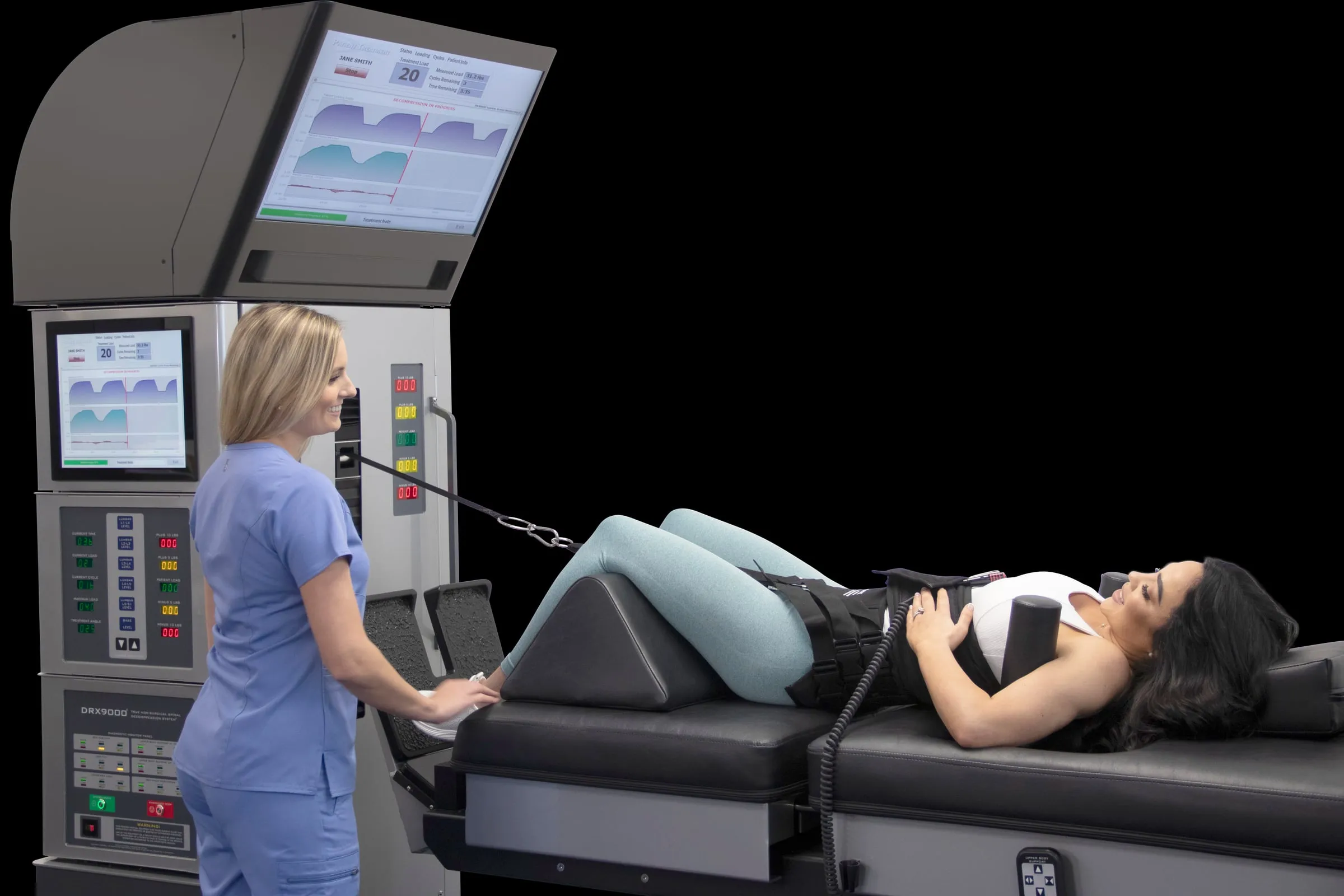
- DRX9000, a system for the lumbar spine (L1–L2 through L5–S1);
- DRX9000C (DRX5000), an add-on to the DRX9000 for the cervical and thoracic spine (C3–C4 through C7–T1);
- DRX9500 (DRX5000), a standalone cervical system with a built-in couch;
- the DRX9000 + DRX9000C (DRX5000) combination system for treating every region of the spine.
How does the DRX9500 differ from the DRX9000C?
Functionally, it doesn’t: both devices are designed to treat the cervical spine. The DRX9500 is a standalone system with an integrated couch. The DRX9000C is an add-on to the DRX9000, and together they form a combination system; the DRX9000C cannot operate on its own.
Who manufactures DRX™ equipment?
Excite Medical (Tampa, Florida, USA). In 2018, Excite Medical acquired all intellectual property related to the DRX9000, including the software, drawings, FDA 510(k) clearances, and DRX trademarks, from the previous developer, Axiom Worldwide.
How long has the technology been in use, and where?
The first DRX-family systems were cleared by the FDA in 2002–2003, and the DRX9000 in 2006. In Russia, DRX9000 therapy has been used since 2006. According to the manufacturer, more than 2,400 DRX9000 systems operate in more than 60 countries.
Are there alternatives to DRX?
DRX™ is a unique localized decompression technology. Unlike traction tables, it acts on one selected spinal segment, and a computer controls the load through a closed feedback loop. Our specialist can help you compare DRX with any specific device you are considering.
Medical Questions
What conditions are DRX™ systems used for?
According to materials from the manufacturer and ELTECH:
- herniated and bulging intervertebral discs;
- recurrent herniations, including after surgery;
- radiculopathy and sciatica;
- osteochondrosis, degenerative disc disease, and spondylosis;
- facet syndrome;
- postoperative rehabilitation, prevention, and athlete rehabilitation.
In every case, the physician makes the treatment decision.
Who should not receive this treatment?
The main contraindications are pregnancy, cancer, spinal instability and unstable spondylolisthesis, fractures, severe osteoporosis, metal hardware and lumbar spinal fusion, spinal infections, sequestered disc herniation, aortic aneurysm, and severe neurological disorders. The full list is in the “For Patients” section.
Is an MRI needed before treatment?
Yes. Using an MRI of the lumbar or cervical spine, the physician determines which segment to treat and which must not be treated, and sets the angle of pull.
Can patients be treated after spine surgery?
Yes, for recurring pain after surgery, but only after a set interval: under the manufacturer’s protocols, 6 months for the lumbar spine and 12 months for the cervical spine. Prior lumbar spinal fusion and metal hardware in the spine rule out treatment.
Are there age or body weight limits?
Under the manufacturer’s protocols, patients must be at least 18 years old. The safe working load of the DRX9000 and DRX9500 table is 181 kg. The physician decides whether treatment is appropriate for older patients.
What results does treatment achieve?
According to the developers, over the course of treatment the intervertebral space increases, the herniation shrinks, and disc hydration and nutrition improve, while the painful segment is mobilized without damaging the spine. In the study by Apfel et al. (2010), disc height in 30 patients increased on average from 7.5 to 8.8 mm, and pain decreased from 6.2 to 1.6 points.
How effective is the method?
In the Gionis & Groteke study (2003), treatment was successful in 86% of 219 patients. Success was defined as pain reduced to 0–1 on a 0-to-5 scale; there was no control group. According to statistics from clinics using DRX in post-Soviet countries, 92% of patients report improvement; these are internal data, not a randomized trial. All studies, with their limitations, are collected in the “Research” section.
Is the procedure safe? Are there side effects?
Published DRX9000 studies describe no serious device-related complications. Brief muscle soreness after a session is possible, as after an intense workout; in some patients symptoms temporarily worsen. The patient can release tension at any time with the safety button, and the physician tailors the load to each patient.
Can DRX be combined with other treatments?
Yes. The procedure is used on its own or as part of a combined program: it is usually supplemented with cold therapy, electrical stimulation, and therapeutic exercise, and following an orthopedic regimen enhances the effect. In acute cases with pronounced muscle spasm, the physician first relieves the flare-up and then starts the DRX course.
What if there is no improvement?
Under the manufacturer’s protocol, the physician reviews progress after 10 sessions. If pain has not decreased by at least half, the physician reconsiders the approach: adjusting the angle and load or considering other treatments, up to and including a surgical consultation.
How long do the results last?
That depends on the diagnosis, lifestyle, and how the patient maintains the result. After the course, the protocol recommends a 4- to 6-week strengthening program for the back muscles. Long-term controlled follow-up of DRX9000 patients is still limited, and the researchers themselves point out this limitation.
The Procedure and Course of Treatment
How long does one session last?
30–45 minutes: about 30 minutes on the DRX™ system and 10–15 minutes for supporting procedures recommended by the treating physician.
How many sessions are in a course?
Under the manufacturer’s protocol, the lumbar course is 20 sessions over 6 weeks, and the cervical course is 18 sessions over 6 weeks. On the physician’s recommendation and depending on the patient’s condition, the number of sessions can be increased.
How often are sessions scheduled?
Lumbar spine: 5 sessions a week for the first 2 weeks, 3 a week for the next 2 weeks, and 2 a week for the last 2 weeks. Cervical spine: 3 sessions a week for 6 weeks.
Does the procedure hurt?
No. It should feel like a light stretch and pressure; many patients fall asleep. If the pull feels strong or painful, the physician reduces the load immediately.
How is the load selected?
The load is calculated from the patient’s body weight and increased gradually, usually over the first few sessions. For the lumbar spine, the manufacturer’s protocol starts with a force slightly less than half of body weight; for the cervical spine, at about 10% of body weight. The physician adjusts the load based on how the patient feels (“less is better”); the load can be increased at the next session.
Should physical activity be limited during the course?
Yes, especially in the first two weeks: the protocol recommends limiting activity and, if prescribed by the physician, wearing a lumbar brace. After the second week, activity is gradually increased. Once the patient has improved by about half, stretching exercises are added to the treatment.
What happens after the course ends?
The patient is advised to follow a 4- to 6-week strengthening program for the back muscles: exercises, posture work and, if needed, cold therapy and electrical stimulation. A follow-up visit with the physician takes place one month after the course.
Equipment and Technical Specifications
What is the maximum force the systems deliver?
According to the manufacturer’s manuals: DRX9000, up to 68 kg (150 lb); DRX9000C and DRX9500, up to 23 kg (50 lb). Force is displayed and set in pounds.
What patient weights can be treated?
The built-in scales measure weights from 5 to 181 kg. The safe working load of the table is 181 kg.
What are the dimensions and weight of the systems?
Weight per the manufacturer’s manuals: DRX9000, 581 kg; DRX9000C add-on, 136 kg; DRX9500, 317 kg. Approximate dimensions: DRX9000, 259 × 81 × 220 cm; combination system, 359 × 81 × 220 cm; DRX9500, 259 × 81 × 132 cm. Please confirm exact dimensions for room planning with a specialist.
What power supply is required?
A grounded 220–240 V, 50–60 Hz outlet; maximum power consumption is 600 W. The manufacturer requires connecting the system to a dedicated circuit with no other equipment on it. A 1000 VA uninterruptible power supply is included and keeps the system running for at least 10 minutes.
What are the operating conditions?
Temperature from 10 to 40 °C, relative humidity 30–75% non-condensing (per the DRX9000 manual).
What comes with the systems?
DRX9000: a computer console with monitor and touch keypad, a split table, pelvic harnesses in three sizes and chest harnesses in two sizes, an air lumbar support pump, an upper-body support system, a platform scale, an operator control pad, a decompression unit, a printer, an uninterruptible power supply, an emergency stop switch, a DVD player and headphones for the patient, and an operating manual. The DRX9000C and DRX9500 cervical systems come with a decompression unit, a touchscreen computer, a laser module, a head support device with inserts in four sizes, a platform scale, safety handrails, and a remote control.
What safety features are built in?
An emergency stop button on the system and a patient safety button that releases tension immediately. A diagnostic indicator panel shows the status of power, motors, limit sensors, and fuses. The system complies with the IEC 60601-1 electrical safety standard for medical equipment and the IEC 601-1-2 electromagnetic compatibility requirements; protection class I, type BF.
Does the system store treatment data?
Yes. The system maintains patient records, documents the parameters of every procedure, and prints a session report.
Installation, Training, and Service
What kind of room is needed for installation?
Approximate floor area: 15–20 m² for a DRX9000 or DRX9500, 20–30 m² for the combination system. No special room finishes are required.
Are there floor or anchoring requirements?
The manufacturer has no special requirements for flooring material: the base must be level and stable. The system does not need to be anchored to the floor. Access is needed from the front and, where possible, from the rear, which makes it easier for the physician to position and secure the patient.
Who delivers and installs the equipment?
ELTECH delivers the system to the clinic, installs it, and performs diagnostics and commissioning. Only trained specialists from the manufacturer or distributor may move an installed system; otherwise the warranty is voided.
How long does staff training take?
2–4 days. The length depends on which equipment was purchased, how many units, and how many people are being trained.
What warranty covers the equipment?
12 months from the installation date. During this period, any part that fails due to a manufacturing defect is replaced or repaired. The warranty does not cover consumable items: chest and pelvic harnesses, knee rest, head pillow, armrests, and the table’s leather upholstery. An extended manufacturer warranty on parts and labor can be purchased no later than 30 days before the standard warranty expires.
Do you service equipment after the warranty ends?
Yes. At the client’s request, ELTECH provides post-warranty service for 9 years, including the supply of original spare parts for the entire service period.
Do you service DRX systems purchased elsewhere?
Yes. ELTECH restores service for previously installed systems and provides post-warranty service to every clinic that owns DRX systems.
Where can I get spare parts?
ELTECH supplies original spare parts for DRX™ systems. The manufacturer maintains a parts inventory to support systems produced since 2001.
Purchasing, Delivery, and Partnership
How can I purchase DRX™ equipment?
Contact ELTECH: we will help you choose a configuration, prepare the contract and arrange delivery. In the regions, equipment can also be purchased from our authorized dealers. Email: info@drx9000.ru.
Which configuration should I choose?
If the clinic plans to have one system, we recommend the DRX9000 + DRX9000C (DRX5000) combination system: it treats both the lumbar and cervical spine. For a full-service spine clinic, we recommend two systems: the combination system and a separate DRX9000, since most patients present with lumbar problems.
What does delivery include?
Delivery includes:
- the DRX™ system;
- delivery to the client’s clinic, including all related costs;
- installation, diagnostics, and commissioning;
- medical training for staff;
- a 12-month warranty;
- a full set of operating documentation.
How much does the equipment cost?
The price depends on the model, configuration, and delivery terms. Please contact a specialist for a current quote for your clinic.
What payment options are available?
We offer flexible payment and partnership models: installment sales, leasing with fixed payments, and rent-to-own. We help with financing and obtaining loans on favorable terms, and we tailor the arrangement to each client; please confirm terms with a specialist.
How quickly does the equipment pay for itself?
DRX™ systems are among the medical devices that pay for themselves quickly, but the payback period depends on how fully the system is booked, how treatment is organized, and how well staff are trained. Our specialist will prepare a calculation for your clinic.
Can we open a medical center together with you?
Yes. Options include a joint venture for strategic partners, joint development of a clinic network, and franchising. Please contact a specialist for details.
How can I become a dealer or representative in my region?
Contact us: we are expanding our dealer network and provide partners with contract support and marketing materials. Email: info@drx9000.ru.
Which countries do you deliver to?
ELTECH is the exclusive distributor of Excite Medical in the CIS and the Baltics and has been working with DRX technology since 2010. We arrange delivery to the clinic ourselves.
Which regions of Russia already have clinics using DRX™?
Altai Krai, the Republic of Tatarstan, the Novosibirsk, Moscow, Ulyanovsk, Tomsk, Tambov, Lipetsk, Orenburg, Kurgan, and Penza regions, the Republic of Bashkortostan, the Khanty-Mansi Autonomous Okrug, Krasnodar Krai, and other regions.
Documents and Registration
Is the equipment FDA cleared?
Yes. The DRX9000 is FDA cleared (510(k)), K060735, 2006. In total, DRX-family systems hold four 510(k) clearances: K022602 (DRX3000, the predecessor of the DRX9000), K023160 (DRX5000, cervical system), K060735 (DRX9000), and K243775 (DRX9000-SL, 2025). The FDA classifies the device as Class II.
Is the equipment registered in Russia?
Yes. DRX™ equipment has undergone technical and clinical testing in Russia and holds a registration certificate and a declaration of conformity. Copies are provided with the equipment; please confirm current document details with a specialist.
What documents do you provide with the equipment?
We provide:
- the sales contract;
- a copy of the registration certificate;
- a copy of the declaration of conformity;
- the device passport in Russian;
- the operating manual in Russian.
Were clinical trials conducted in Russia?
Yes. In 2006, as part of registration, clinical trials of the DRX9000 were conducted on 21 patients in the neurology department of City Clinical Hospital No. 40. The authors of the report recommended the system for use in medical practice in the Russian Federation. Details are in the “Research” section.
What certifications does the manufacturer hold?
According to Excite Medical, the company’s quality management system is certified to ISO 13485:2016 and under the MDSAP program, and the facility is registered with the FDA.
Which legal entity signs the contract?
The contract can be signed with one of our legal entities, including directly with our parent company in the USA. The choice depends solely on the client’s preference.
Is the equipment subject to VAT?
According to company materials, DRX™ equipment has not been subject to VAT. Please confirm the current tax treatment for delivery to your country with a specialist when preparing the contract.
No results found. Ask a specialist.