
Technology
Targeted Decompression: Precise Treatment of the Exact Disc
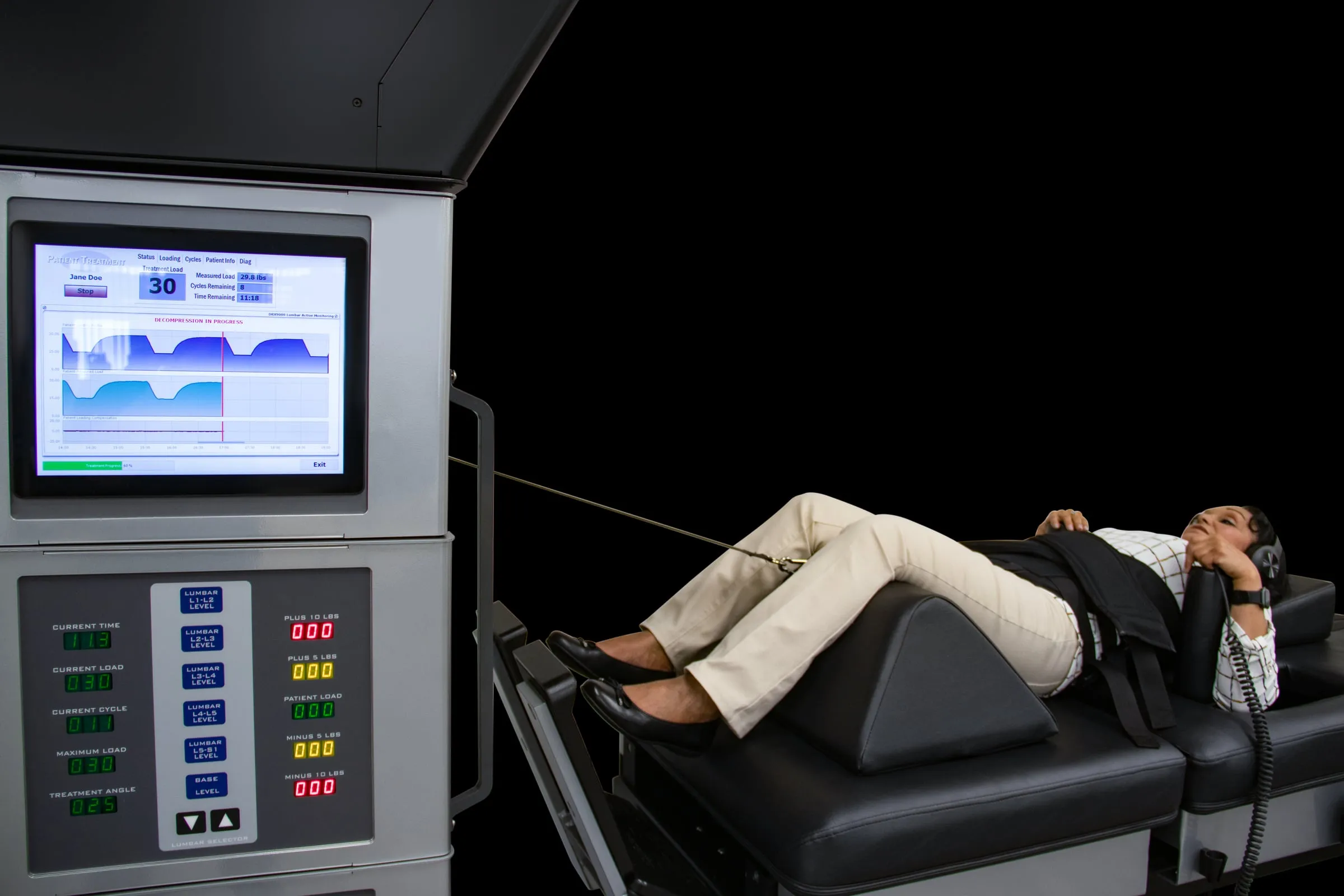
DRX™ systems treat only one spinal segment: the one causing the pain. A computer, a servo drive, and a closed feedback loop set and continuously monitor every force applied.
The Core Idea
Offloading One Segment Instead of Stretching the Whole Spine
Conventional traction (hanging from a bar, underwater traction, traction tables) stretches every spinal segment at once. Only a small fraction of the pulling force reaches the affected disc, and the patient’s body geometry is not taken into account. As a result, the benefit of this kind of traction is usually short-lived.
The DRX™ method takes the opposite approach: targeted decompression of two adjacent vertebrae with the damaged intervertebral disc between them. Force is directed at a calculated angle precisely to the required level: L1-L2 through L5-S1 on the DRX9000, and C3-C4 through C7-T1 on the cervical systems.
The force and direction of pull are computer-controlled under the physician’s supervision. Before the course begins, the physician uses a lumbar or cervical MRI to determine which segment to treat and which must not be loaded.
Mechanism of Action
The Vacuum Effect: The Disc Regains Volume and Nutrition
When two adjacent vertebrae are gently separated in a dedicated computer-controlled mode, negative pressure develops inside the disc. Physicians compare it to a pump: the vertebral body is the piston, and the intervertebral disc with its annulus fibrosus is the cylinder.
Negative pressure does two things. It draws the bulging material (protrusion, herniation) back into the disc space, and it increases fluid flow into the nucleus pulposus from the hyaline cartilage of the vertebral endplates. Interstitial fluid nourishes the disc by diffusion, and the disc restores its volume like a sponge. The herniation stops compressing the nerve roots, and chronic pain subsides.
The intervertebral space is widened in gradual, cyclic steps, so the segment’s muscles and ligaments are not injured.
- Intervertebral space increases
- Disc herniation shrinks
- Disc hydration and mass increase, supporting disc recovery
- Surrounding ligaments and muscles are strengthened
- The painful segment is mobilized without harming the spine
Three Principles
What Makes DRX™ Systems Effective
What sets DRX™ systems apart from other devices on the global market is the combination of effectiveness, precision, and safety. Three engineering solutions make it possible.
-
One Segment, Maximum Force
Treatment is directed only at the spinal segment causing the pain. Discs in other segments are not drawn into traction, so the maximum force is delivered to the damaged disc itself. -
Overcoming Muscle Resistance
A unique mechanism for overcoming muscle resistance keeps the patient’s body as relaxed as possible. Protective spasm does not interfere with offloading the disc, so treatment of the damaged segment remains effective. -
Closed Feedback Loop
A system of closed feedback loops ensures high precision and safety: actual tension is continuously measured and adjusted to the target profile. This is what distinguishes DRX™ systems from other decompression devices.
Force Control
Servo Drive, Logarithmic Curve, and a Precise Angle of Pull
A servo drive instead of weights. Force is generated by the decompression unit, a patented electromechanical device with a servo drive and its own microprocessor. The computer running the treatment program continuously sends commands to the servo amplifier, while load cells built into the decompression unit measure the actual force. This lets the system account for changes in the patient’s posture and for external forces, and the patient feels continuous, smooth tension.
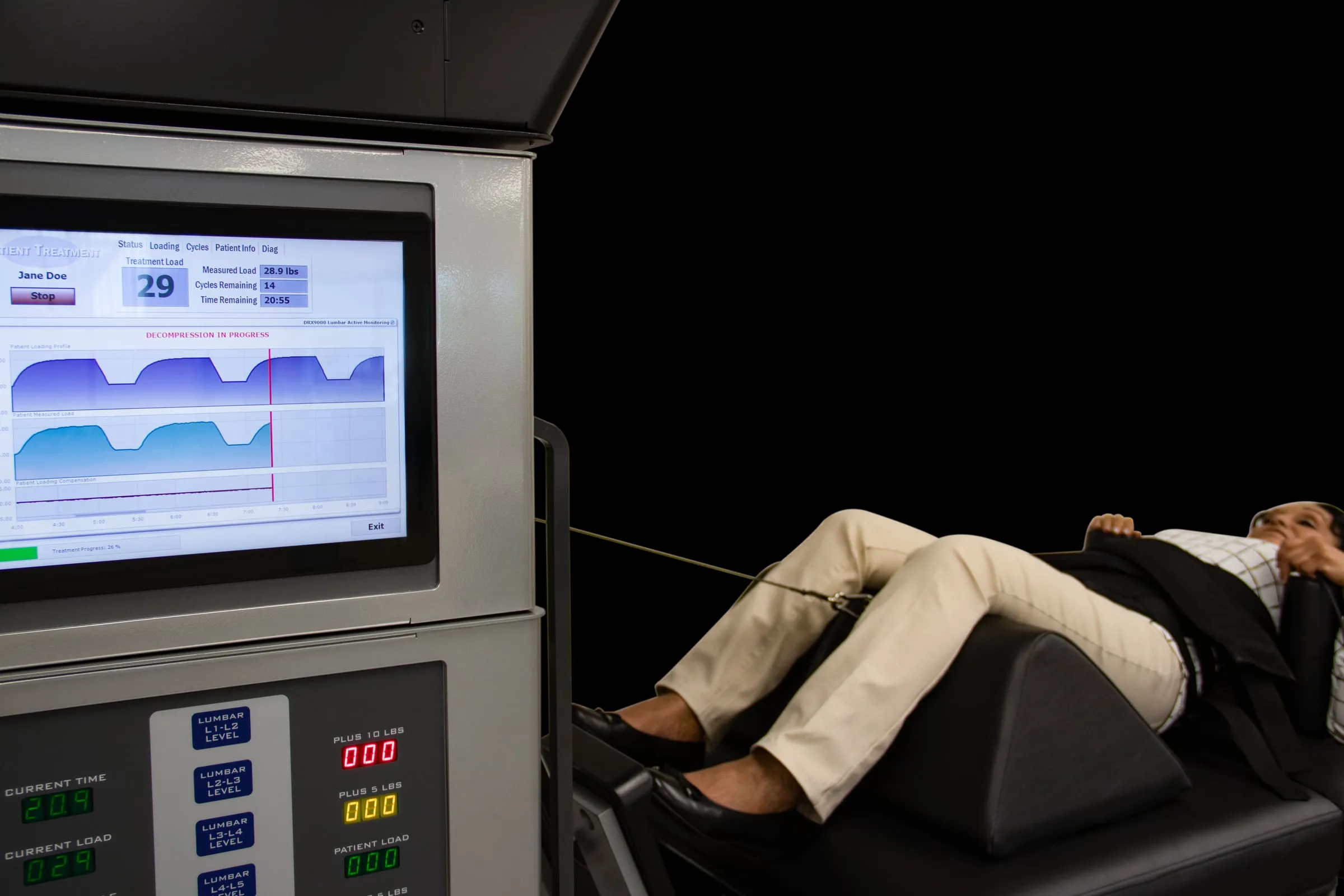
Logarithmic force curve. Tension rises along a logarithmic curve to the set maximum load, holds for a set time, then decreases to the minimum load and holds again. Each maximum–minimum pair makes up one cycle, and the operator sets the number of cycles. Transitions between plateaus are nonlinear and smooth. For the cervical spine, five ramp profiles are available, from the gentlest (profile 1) to the most intensive (profile 5).
Real-time monitoring. The operator’s screen shows three graphs at once: the target load profile, the actual force acting on the patient, and the real-time corrections the system makes so that actual pull matches the target. Tension measurement accuracy is ensured by factory calibration of every unit.
An angle of pull matched to the specific disc. The angle is set based on the MRI. On the DRX9000, the lumbar level selector has six presets: L5 at 10°, L4 at 15°, L3 at 20°, L2 at 23°, L1 at 25°, and 0°, plus manual fine-tuning. The cervical systems have presets of C3 at 2°, C4 at 4°, C5 at 8°, C6 at 13°, C7 at 17°, and 0°. A lordotic air cushion in the table supports the natural curve of the lower back and helps target the treatment to the right level.
The Muscle Factor
Relaxed Muscles, Offloaded Disc
Conventional traction machines have two well-known drawbacks. Sudden loading triggers protective spasm of the paravertebral muscles, which prevents the disc from being offloaded. And after the session, the muscle memory effect kicks in: the muscles pull every spinal element back to its original position and cancel out the therapeutic effect.
The DRX9000 eliminates this drawback. According to the device description submitted to the FDA, the system applies precisely metered tension designed to relax the paravertebral muscles and “bypass” their guarding response, and only then decompress the intervertebral space. Alternating tension and relaxation allows the treatment to be dosed precisely and avoids the adverse effects of older traction methods.
The design itself also promotes relaxation:
- A floating lower table section reduces friction: with each cycle the lower body moves independently of the upper body, which is held by a chest harness and axillary supports, so the intervertebral segments decompress at their own pace. The section is locked during the first pull and unlocked during the first rest phase.
- The supine position, with knee support and a head pillow, requires no effort from the patient.
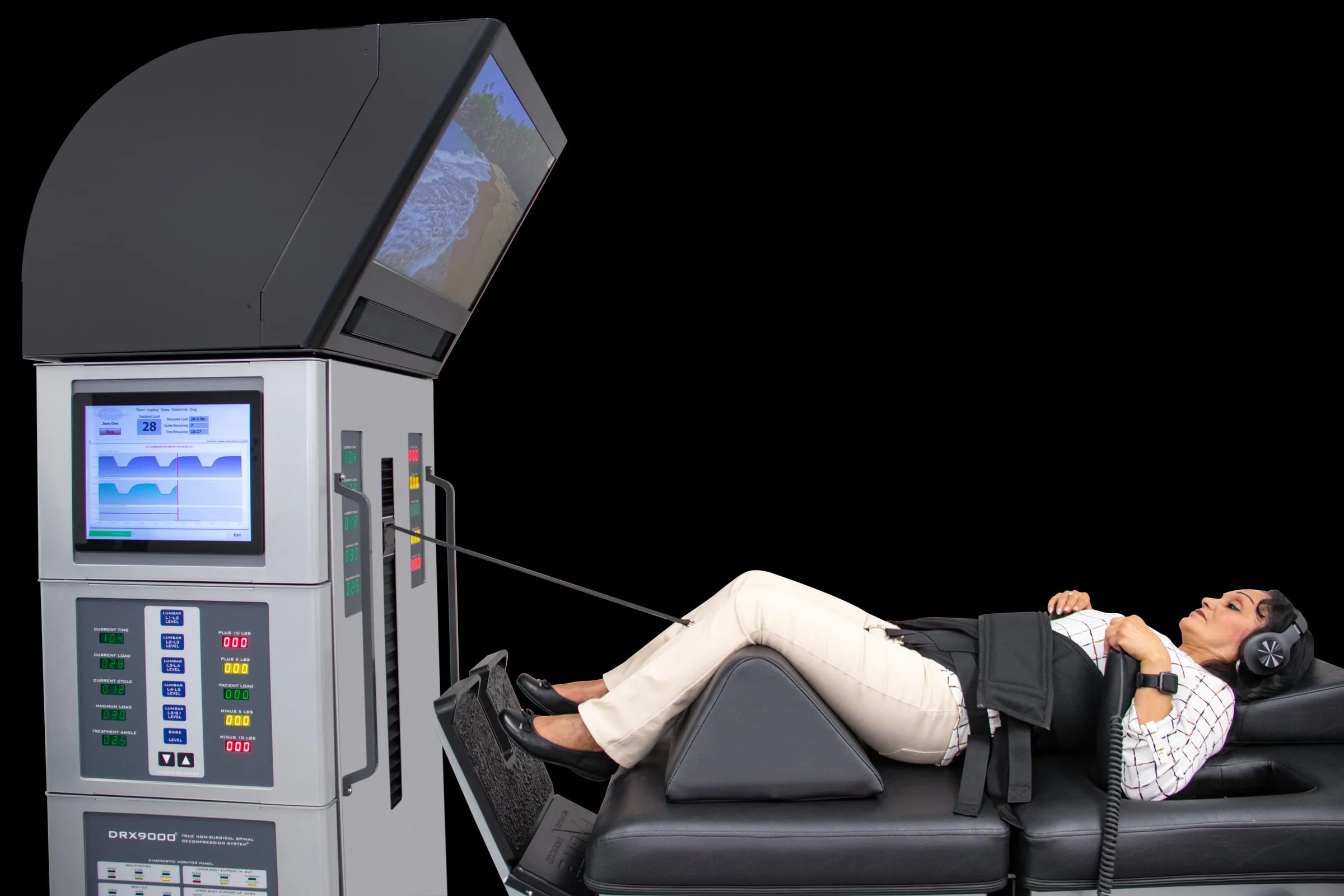
- Monitor and headphones: the patient watches a video or listens to music, which helps them relax mentally.
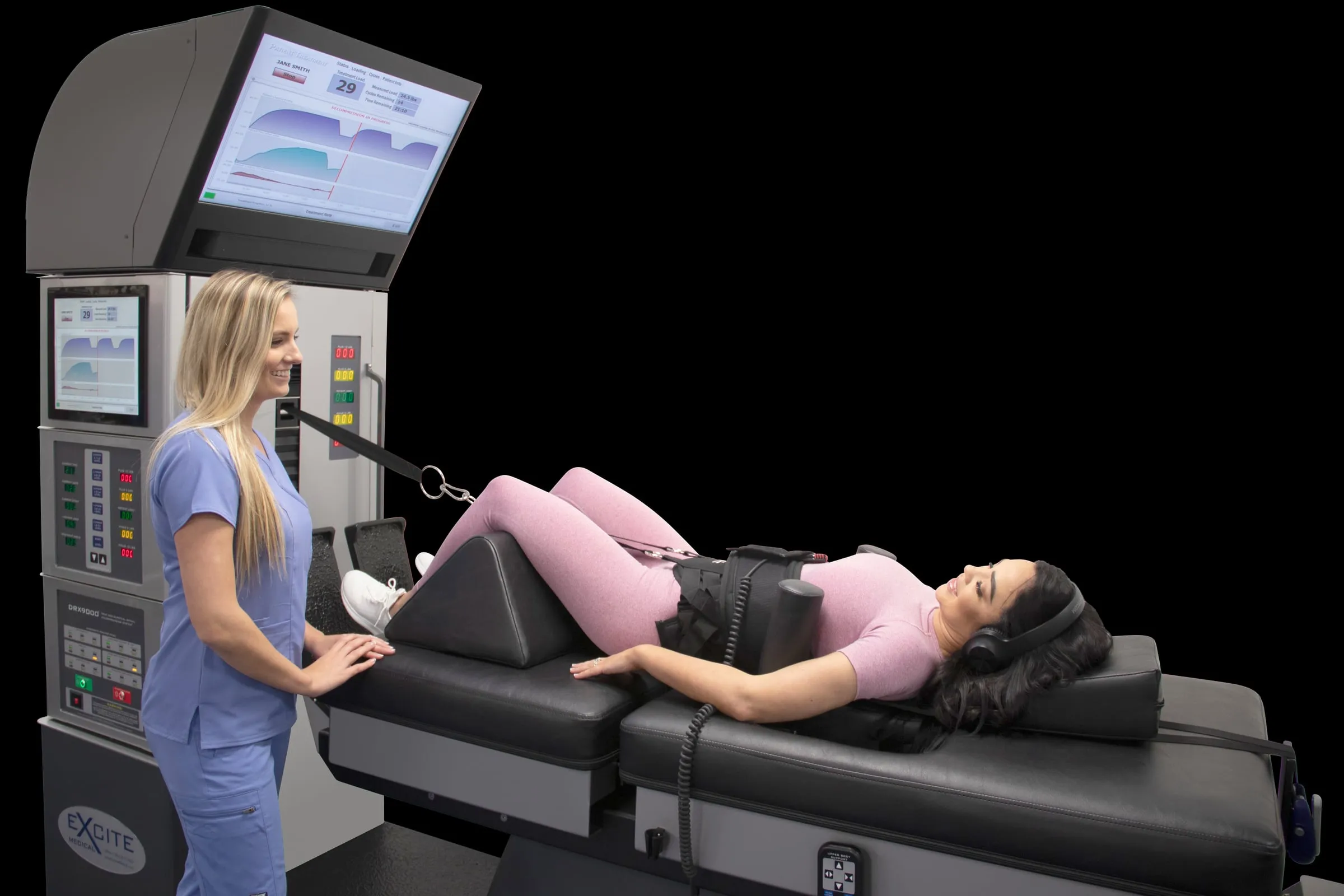
Inside the DRX9000
System Components
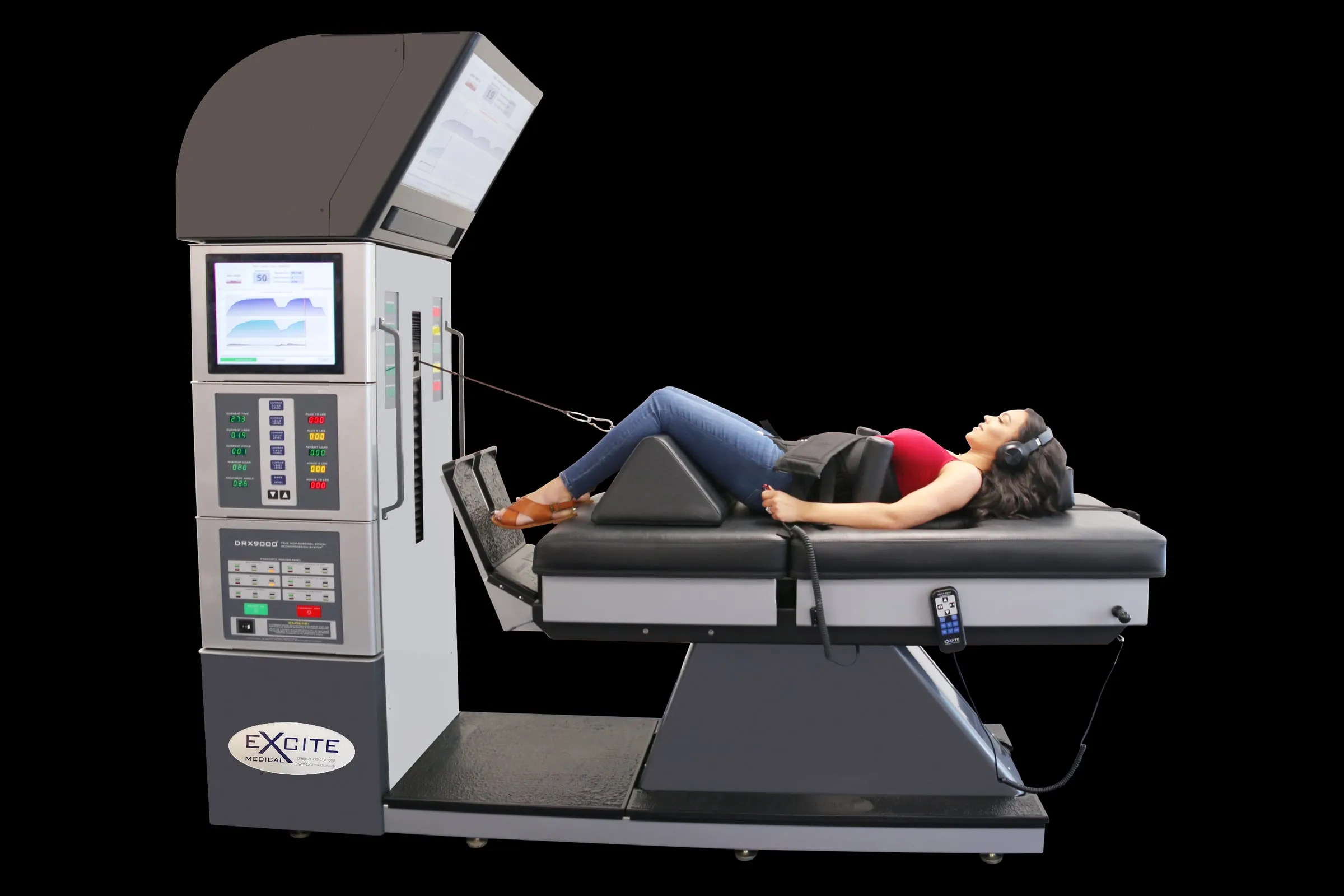
The main components of the DRX9000 lumbar system, according to the operator’s manual and the manufacturer’s description.
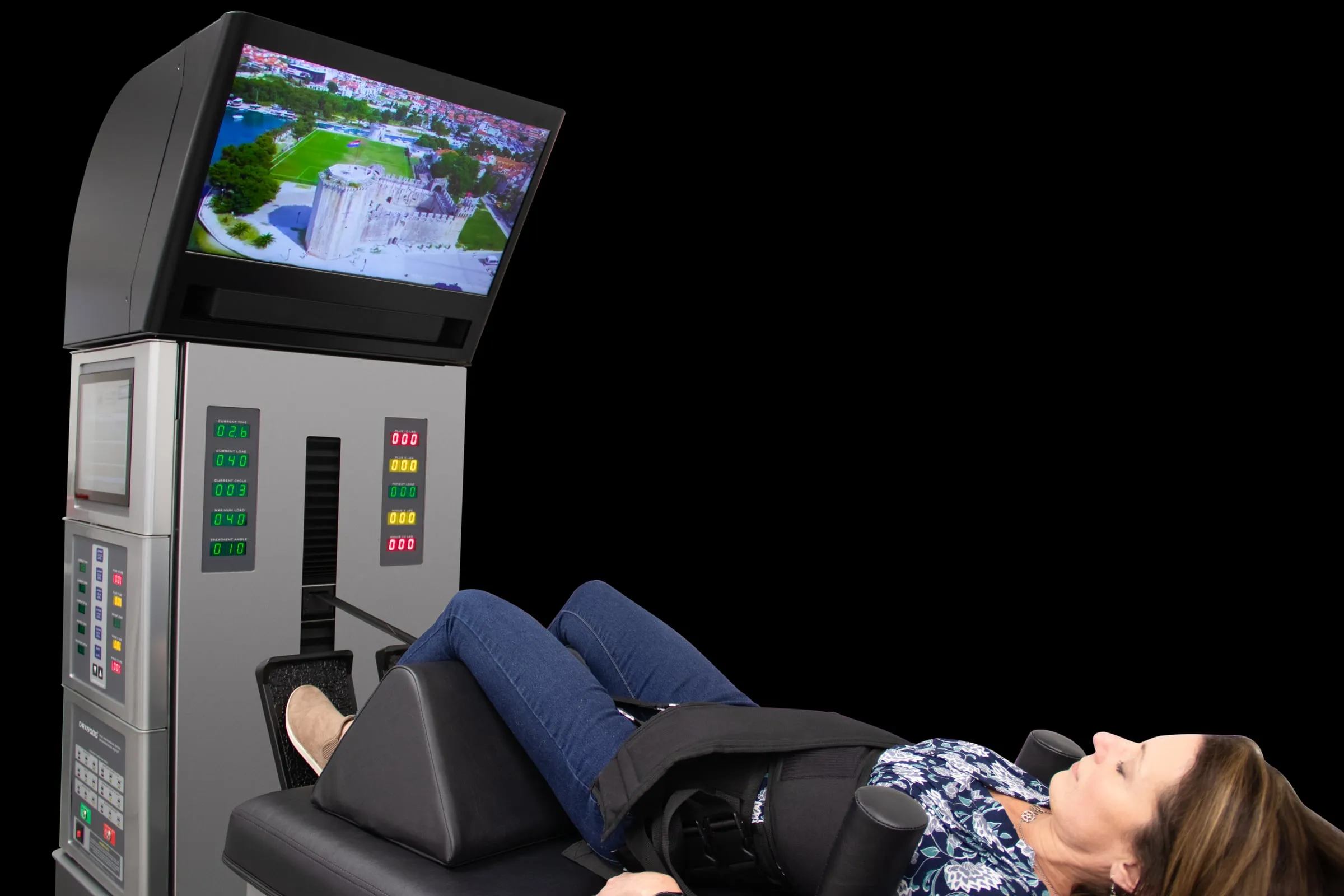
- 1
Patient Monitor
A screen the patient can see during treatment: educational videos, movies, or music through headphones help them relax.
- 2
Touchscreen Computer
A Windows-based touchscreen computer: the operator enters the protocol quickly, and the database stores each patient’s session history.
- 3
Treatment Dynamics Displays
Large displays visible from across the room: current load, cycle number, time, maximum pull, and angle.
- 4
Lumbar Level Selector
Six preset angles of pull (0–25°) and manual fine-tuning to target a specific disc.
- 5
Positioner and Tension Strap
Force is transmitted to the patient through the tension strap; the positioner raises and lowers the pull point. Inside the tower is the decompression unit with its servo drive and microprocessor.
- 6
Upper Body Support System
A pair of axillary supports with motorized four-way adjustment, together with the chest harness, secures the upper torso.
- 7
Harness Tensioner
Tightens and secures the upper body harness to the table during decompression.
- 8
Pelvic and Chest Harnesses
Two-part restraint in multiple sizes: the pelvic harness with its ring takes the pull, while the chest harness holds the upper body.
- 9
Split Table with Floating Lower Section
A soft, two-section leather table moves from vertical to horizontal; the lower section “floats” to reduce friction.
- 10
Lordotic Air Cushion
An inflatable bladder in the table’s upper cushion supports the natural lumbar lordosis.
- 11
Platform Scale
The patient stands on the platform next to the raised table, and their weight is automatically sent to the software to calculate loads.
- 12
Patient Safety Switch
Held in the patient’s hand: pressing it immediately reduces tension to zero and ends the treatment. The device will not operate unless the switch is connected.
- 13
Operator Control Pendant
Controls table height and tilt, the axillary supports, the air cushion, and the lower section lock.
- 14
Power and Emergency Stop
Powered on via a 15-amp circuit breaker; the Stop button releases force immediately. Built-in diagnostics continuously monitor critical subsystems.
Decompression vs. Traction
Why the DRX9000 Is More Than Traction
This is the key question physicians and patients ask. Here is a fact-based comparison drawn from the manufacturer’s manuals and clinical materials.
Sources: DRX9000, DRX9000C, and DRX9500 operator’s manuals (Excite Medical); device description in 510(k) K060735; the article “Who’s Who in Medicine” (in Russian); an article prepared for the journal Neurosurgery (Russian); ELTECH presentation. Individual results may vary.
Safety
Safety Built into the Design
Every level of the system is designed to keep force precise and the patient in control.
-
Patient Safety Switch
The patient holds it throughout the session. Pressing it immediately reduces tension to zero and ends the treatment. If the switch is disconnected or faulty, the device will not start. -
Operator Emergency Stop
The Stop button releases treatment force immediately. On the cervical systems, angle adjustment is locked during treatment, and when the head harness is connected, the DRX9000 table motors are disabled. -
Continuous Force Monitoring
Tension is measured continuously and adjusted to the set value. Measurement resolution is 0.1 lb, with accuracy ensured by factory calibration. -
Uninterruptible Power
Every system ships with a 1000 VA uninterruptible power supply that provides at least 10 minutes of battery operation. -
MRI- and Protocol-Based Settings
The segment and angle are selected from the MRI, and loads are calculated from the patient’s weight. The manufacturer’s protocol recommends starting conservatively and reducing the load by 10–25% if the pull feels strong. -
Regulatory Status
The DRX9000 is FDA-cleared (510(k), K060735); the DRX5000 cervical system is cleared under 510(k) K023160. DRX™ equipment holds registration certificates from Roszdravnadzor (Russia’s Federal Service for Surveillance in Healthcare) and declarations of conformity.
Step by Step
What a DRX9000 Session Looks Like
A session on the device takes about 30 minutes, or 30–45 minutes including supporting procedures.
- 01
Fitting the Harnesses
The pelvic and chest harnesses are sized and fitted to the patient. - 02
Weighing on the Platform
The table is moved to the vertical position and the patient steps onto the platform scale. Their weight goes straight into the software, and the system suggests maximum and minimum loads. - 03
Moving to Horizontal
The table lowers smoothly until the patient is lying on their back. The harnesses are secured, the axillary supports are brought into position, and a support is placed under the knees. - 04
Setting the Protocol
Based on the MRI, the physician sets the angle for the target disc and specifies the loads, phase times, and number of cycles. The patient is handed the safety switch. - 05
Decompression
Cycles of tension and relaxation follow the set profile. The patient watches a video or listens to music, and many fall asleep. The operator monitors the graphs and, if needed, adjusts the load starting with the next cycle. - 06
Finishing Up
Tension is released, the table returns to vertical with a pause, and the patient steps off the platform. Cold therapy and electrical stimulation follow as prescribed by the physician.
By the Numbers
The Technology by the Numbers
- 0–68 kgDRX9000 pull range0–150 lb; cervical systems 0–23 kg. Excite Medical operator’s manuals
- 6preset angles of pulllumbar 0–25°, cervical 0–17°, plus manual fine-tuning
- 30 minsession on the devicecourse: 20 sessions for the lumbar spine, 18 for the cervical spine, over 6 weeks
- 7.5 → 8.8 mmdisc height before and after the courseApfel et al., BMC Musculoskeletal Disorders, 2010; retrospective study, 30 patients
- 86%treatment success in a study of 219 patientsGionis & Groteke, Orthopedic Technology Review, 2003; single-arm study, success defined as pain reduced to 0–1 points